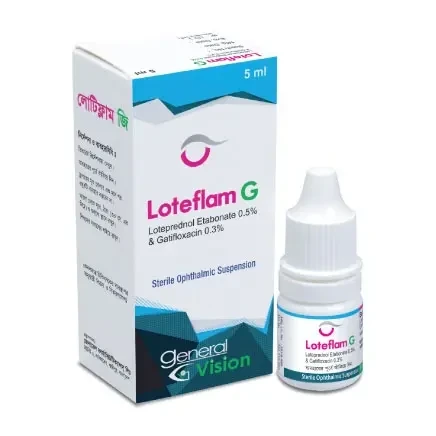
Loteflam G Ophthalmic Suspension 5 ml drop, Loteprednol Etabonate + Gatifloxacin 0.5%+0.3%
Inhouse product
-
 ৳11.40
৳12.00 -
৳42.75
৳45.00 -
৳16.63
৳17.50 -
৳2.14
৳2.25 -
৳9.50
৳10.00


Reviews & Ratings
Indications
This ophthalmic
suspension is indicated for steroid-responsive inflammatory ocular conditions
for which a corticosteroid is indicated and where superficial bacterial ocular
infection or a risk of bacterial ocular infection exists. Ocular steroids are
indicated in inflammatory conditions of the palpebral and bulbar conjunctiva,
cornea and anterior segment of the globe such as allergic conjunctivitis, acne,
superficial punctate keratitis, herpes zoster keratitis, iritis, and cyclitis.
It is also indicated for the treatment of post-operative inflammation following
ocular surgery.
* রেজিস্টার্ড চিকিৎসকের পরামর্শ মোতাবেক ঔষধ সেবন করুন'
Pharmacology
Loteprednol
(corticosteroids) are thought to act by the induction of phospholipase A2
inhibitory proteins, collectively called lipocortins. It is postulated that
these proteins control the biosynthesis of potent mediators of inflammation
such as prostaglandins and leukotrienes by inhibiting the release of their
common precursor arachidonic acid. Arachidonic acid is released from membrane
phospholipids by phospholipase A2.
Gatifloxacin is an 8-methoxyfluoroquinolone with a 3-methylpiperazinyl
substituent at C7. The antibacterial action of gatifloxacin results from
inhibition of DNA gyrase and topoisomerase IV. DNA gyrase is an essential
enzyme that is involved in the replication, transcription, and repair of
bacterial DNA. Topoisomerase IV is an enzyme known to play a key role in the
partitioning of the chromosomal DNA during bacterial cell division. The
mechanism of action of fluoroquinolones including gatifloxacin is different
from that of aminoglycoside, macrolide, and tetracycline antibiotics.
Therefore, gatifloxacin may be active against pathogens that are resistant to
these antibiotics and these antibiotics may be active against pathogens that
are resistant to gatifloxacin. Gatifloxacin has been shown to be active against
most isolates of the following organisms both microbiologically and clinically.
Aerobic Gram-Positive Bacteria: Staphylococcus aureus, Staphylococcus
epidermidis, Streptococcus mitis group, Streptococcus oralis, Streptococcus
pneumoniae.
Aerobic Gram-Negative Bacteria: Haemophilus influenza.
Dosage & Administration
Apply one or two drops
of sterile ophthalmic suspension into the conjunctival sac of the affected
eye(s) every four to six hours. During the initial 24 to 48 hours, the dosing
maybe increased, to every one to two hours. Frequency should be decreased
gradually as warranted by improvement in clinical signs. Care should be taken
not to discontinue therapy prematurely.
* রেজিস্টার্ড চিকিৎসকের পরামর্শ মোতাবেক ঔষধ সেবন করুন'
Interaction
No drug interaction is
reported yet. If several medicines are to be administered to the eye, there
should be an interval of at least 5 minutes between each application.
Contraindications
This sterile
ophthalmic suspension is contraindicated in most viral diseases of the cornea
and conjunctiva including epithelial herpes simplex and also in mycobacterial
infection of the eye and fungal diseases of ocular structures. It is also
contraindicated in known hypersensitivity to any of the ingredients of this
preparation. It is also contraindicated in patients with a history of
hypersensitivity to other quinolones, acetylsalicylic acid and other no
steroidal inflammatory medicines.
Side Effects
Adverse reactions have
occurred with steroid/anti-infective combination drugs which can be attributed
to the steroid component or the anti-infective component, or the combination.
Reactions associated with ophthalmic steroids include elevated IOP, which may be
associated with infrequent optic nerve damage, visual acuity and field detects,
posterior sub capsular cataract formation, delayed wound healing, and secondary
ocular infections from pathogens including herpes simplex, and perforation of
the globe where there is thinning of cornea or sclera. The most frequently
reported adverse effects for gatifloxacin in the overall study population were
conjunctival irritation, increased lacrimation, keratitis and papillary
conjunctivitis. These events occurred in approximately 5-10% of patients. Other
reported reactions occurring in 1-4% of patients were chemosis, conjunctival
hemorrhage, dry eye, eye discharge, eye irritation, eye pain, eyelid edema,
headache, red eye, reduced visual acuity and taste disturbance. Redness was the
most commonly observed adverse event occurring in 6%. Itching, discharge
photophobia and blurred vision were seen in less than 2% cases.
Pregnancy & Lactation
Pregnancy Category C.
There are no adequate and well-controlled studies in pregnant women. It should
be used during pregnancy only if the potential benefit justifies the potential
risk to the fetus. It is not known whether this drug is excreted in human milk.
Because many drugs are excreted in human milk, caution should be exercised when
this is administered to a nursing woman.
Precautions & Warnings
The preparation should
not be injected sub conjunctively, nor should it be introduced directly into
the anterior chamber of the eye. If Loteflam G is used for 10 days or longer,
intraocular pressure should be monitored. Fungus invasion must be considered in
any persistent corneal ulceration where a steroid has been used or is in use.
If redness or itching becomes aggravated, the patient should be advised to
consult a physician. Patients who wear soft contact lenses and whose eyes are
not red, should be instructed to wait at least ten minutes after instilling it
before they insert their contact lenses.
Therapeutic Class
Ophthalmic Steroid
preparations
Storage Conditions
Store at room
temperature & protect from light. Do not touch dropper tip to any surface.
It is desirable that the contents should not be used one month after first
opening of the bottle. Protect from freezing.
Frequently Bought Products

Larsulin SC Injection 3ml cartridge,Insulin Glargine 100 IU/ml

Fungidal Cream 15gm, Miconazole Nitrate 2% w/w

Galfin Capsule, Fluconazole 150 mg

Dophylin Tablet, Doxophylline 400 mg

Anquil IM/IV Injection, Midazolam 15 mg/3 ml

Claricin Tablet, Clarithromycin 250 mg

Antixa Tablet, Apixaban 5 mg

Acme's Dextrose IV Infusion 500 ml bag, Dextrose 5%
![Folive Capsule, 6s-5-Methyltetrahydrofolate [Bio-Active Folate] 400 mcg](https://old.skpharma.com.bd/public/uploads/all/1jo5kUKotnycSmtIdEOw4Nb0Vt6ExNjG1gR9YkHr.webp)
Product Queries (0)
Login Or Registerto submit your questions to seller
Other Questions
No none asked to seller yet
-
৳11.40
৳12.00 -
৳42.75
৳45.00 -
৳16.63
৳17.50 -
৳2.14
৳2.25 -
৳9.50
৳10.00