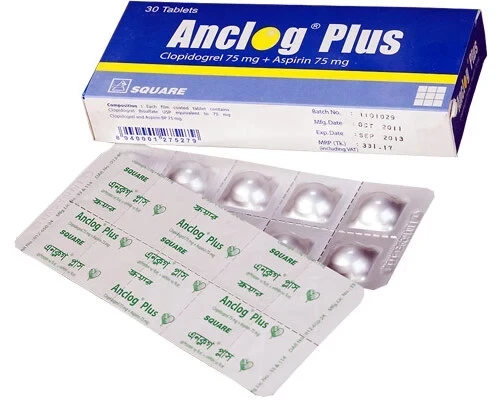
Anclog Plus Tablet , Clopidogrel + Aspirin 75 mg+75 mg
Inhouse product
-
 ৳11.40
৳12.00 -
৳42.75
৳45.00 -
৳16.63
৳17.50 -
৳2.14
৳2.25 -
৳9.50
৳10.00


Reviews & Ratings
Indications
Acute Coronary Syndrome (ACS): Anclog Plus is indicated to reduce the rate
of Myocardial Infarction (MI) and Stroke in patients with non-ST-segment
elevation ACS [unstable angina (UA)/non-ST-elevation Myocardial Infarction
(NSTEMI)] and acute ST-segment elevation ACS [ST-elevation Myocardial
Infarction (STEMI)].
Recent
MI, recent Stroke, or established Peripheral Arterial Disease: In patients with
established peripheral arterial disease or with a history of recent Myocardial
Infarction (MI) or recent Stroke it is indicated to reduce the rate of MI and
Stroke.
* রেজিস্টার্ড চিকিৎসকের পরামর্শ মোতাবেক ঔষধ সেবন করুন'
Pharmacology
Clopidogrel
is a prodrug. It inhibits platelet activation and aggregation through the
irreversible binding of its active metabolite to the P2Y12 class of ADP
receptors on platelets. Dose-dependent inhibition of platelet aggregation can
be seen at 2 hours after single oral doses. Repeated doses of 75 mg per day
inhibit ADP-induced platelet aggregation on the first day, and inhibition
reaches steady state between Day 3 and Day 7.
Aspirin inhibits platelet aggregation by irreversible inhibition of platelet
cyclooxygenase and thus inhibiting the generation of thromboxane A2 a powerful
inducer of platelet aggregation and vasoconstriction.
Pharmacokinetics: After repeated 75-mg
oral doses of Clopidogrel (base), plasma concentrations of the parent compound,
which has no platelet inhibiting effect, are very low and are generally below
the quantification limit (0.00025 mg/L) beyond 2 hours after dosing.
Clopidogrel is extensively metabolized by the liver. The main circulating
metabolite is the carboxylic acid derivative, and it has no effect on platelet
aggregation. It represents about 85% of the circulating drug-related compounds
in plasma. Following an oral dose of 14C-labeled Clopidogrel in humans,
approximately 50% is excreted in the urine and approximately 46% in the faeces
in the 5 days after dosing. The elimination half-life of the main circulating
metabolite is 8 hours after single and repeated administration. Administration
of Clopidogrel with meals did not significantly modify the bioavailability of
Clopidogrel as assessed by the pharmacokinetics of the main circulating
metabolite.
Absorption
and Distribution: Clopidogrel is rapidly absorbed after oral administration of
repeated doses
of 75 mg Clopidogrel (base), with peak plasma levels (3 mg/L) of the main
circulating metabolite occurring approximately 1 hour after dosing. The
pharmacokinetics of the main circulating metabolite are linear (plasma
concentrations increased in proportion to dose) in the dose range of 50 to 150
mg of Clopidogrel.
Absorption is at least 50% based on urinary excretion of Clopidogrel-related
metabolites. Clopidogrel and the main circulating metabolite bind reversibly in
vitro to human plasma proteins (98% and 94%, respectively). The binding is
nonsaturable in vitro up to a concentration of 100 g/mL.
Metabolism
and Elimination: In vitro and in vivo, Clopidogrel undergoes rapid hydrolysis
into its carboxylic acid derivative. In plasma and urine, the glucuronide of
the carboxylic acid derivative is also observed.
Dosage &
Administration
The
recommended dose of Clopidogrel is 75 mg once daily with or without food. No
dosage adjustment is necessary for elderly patients or patients with renal
patients. For patients with acute coronary syndrome (unstable angina/non-Q-wave
MI), Clopidogrel should be initiated with a single 300 mg loading dose and then
continued at 75 mg once daily. Aspirin (75 mg-325 mg once daily) should be
initiated and continued in combination with Clopidogrel. In studies it was
found that most patients with acute coronary syndrome also received heparin
acutely.
* রেজিস্টার্ড চিকিৎসকের পরামর্শ মোতাবেক ঔষধ সেবন করুন'
Interaction
Study
of specific drug interactions yielded the following results:
Aspirin: Aspirin does not modify
the Clopidogrel-mediated inhibition of ADP-induced platelet aggregation.
Clopidogrel potentiates the effect of aspirin on collagen-induced platelet
aggregation.
Heparin: Clopidogrel does not
necessitate modification of the heparin dose or alter the effect of heparin on
coagulation. Co-administration of heparin has no effect on inhibition of
platelet aggregation induced by Clopidogrel.
Nonsteroidal
Anti-Inflammatory Drugs (NSAIDs): Concomitant administration of Clopidogrel is
associated with increased occult gastrointestinal blood loss. NSAIDs and
Clopidogrel should be co-administered with caution.
Warfarin: The safety of the
co-administration of Clopidogrel with warfarin has not been established.
Consequently, concomitant administration of these two agents should be
undertaken with caution.
Contraindications
This
combination is contraindicated in the following conditions: Hypersensitivity to
the drug substance or any component of the product. Active pathological
bleeding such as peptic ulcer or intracranial hemorrhage.
Side Effects
Anclog
Plus is generally well tolerated.
Pregnancy &
Lactation
There
are no adequate and well-controlled studies in pregnant women. It should be
used during first and second trimesters of pregnancy only if clearly needed. It
is contraindicated during the third trimester of pregnancy. It is unknown
whether Clopidogrel is excreted in human breast milk but Aspirin is known to be
excreted in human milk. This Drug should be discontinued during the breast
feeding.
Precautions &
Warnings
- Anclog
Plus may prolongs the bleeding time.
- Thrombotic thrombocytopenic purpura (TTP): TTP has been reported rarely
following use of Anclog Plus.
- Reye's syndrome: Reye's syndrome may develop in individuals who have
chicken pox, influenza or flu symptoms. Hypersensitivity including rash,
angioedema or hematologic reaction has been reported in patients receiving
Anclog Plus or history of hypersensitivity to other thienopyridines
Use in Special
Populations
It
should not be given to children, particularly those under 12 years, unless the
expected benefits outweight the possible risks. Aspirin may be a contributory
factor in the causation of Reye’s syndrome in some children.
Overdose Effects
Clopidogrel
overdose may lead to bleeding complications. Based on biological plausibility,
platelet transfusion may restore clotting ability. In moderate aspirin
intoxication dizziness, headache, tinnitus, confusion, and gastrointestinal
symptoms may occur which can be treated by inducing vomiting followed by
gastric lavage if needed. In severe Aspirin intoxication respiratory alkalosis
respiratory acidosis, metabolic acidosis, hyperthermia, perspiration,
dehydration can occur. It can be treated with haemodialysis and other
symptomatic treatment.
Therapeutic Class
Anti-platelet
drugs
Storage Conditions
Keep
in a cool & dry place (below 30ºC), protected from light & moisture.
Keep out of the reach of children.
Frequently Bought Products
Product Queries (0)
Login Or Registerto submit your questions to seller
Other Questions
No none asked to seller yet
-
৳11.40
৳12.00 -
৳42.75
৳45.00 -
৳16.63
৳17.50 -
৳2.14
৳2.25 -
৳9.50
৳10.00